

The Pendulum
of Trauma
A guided workbook for the shields you built, and deciding where they still belong.
- ✓ Instant PDF download
- ✓ Fillable on any device
- ✓ Printable
- ✓ Lifetime access
- ✓ Written by a licensed psychotherapist
Where do you lean?
Most people don't live at one extreme all the time - making yourself small, or standing on guard. Notice which shield you reach for more often.
| Rigid Armor | Invisibility |
|---|---|
| You stay on high alert, even when you're safe. | You make yourself smaller, quieter, or more agreeable to avoid conflict. |
| You feel the need to control every detail so nothing goes wrong. | You go along with things you don't agree with to keep the peace. |
| You react more strongly than the situation calls for or over-manage to prevent something bad from happening. | You continue playing this role even when you no longer need to. |


What's inside
Each section pairs a short reflection with a worksheet - no clinical background needed, no right pace to keep. Fill it out digitally or print it and work by hand.
- Armor and InvisibilityTwo kinds of shield
- Not What’s Happening: What HappenedWhat the nervous system remembers
- Built With PrecisionThe shield, not the flaw
- The Mechanism Is IdenticalAdaptations beyond childhood
- Not Bound to the Timing of the EventThe dam and the delay
- The Mind as LibrarianWhy? and the unknown file
- What NowFrom armor to repositioning
- When Invisibility Was the ArmorThe absence of a shield
Plus a reusable Weekly Pendulum Check-In tracker - print it as many times as you need, long after you've finished the workbook itself.
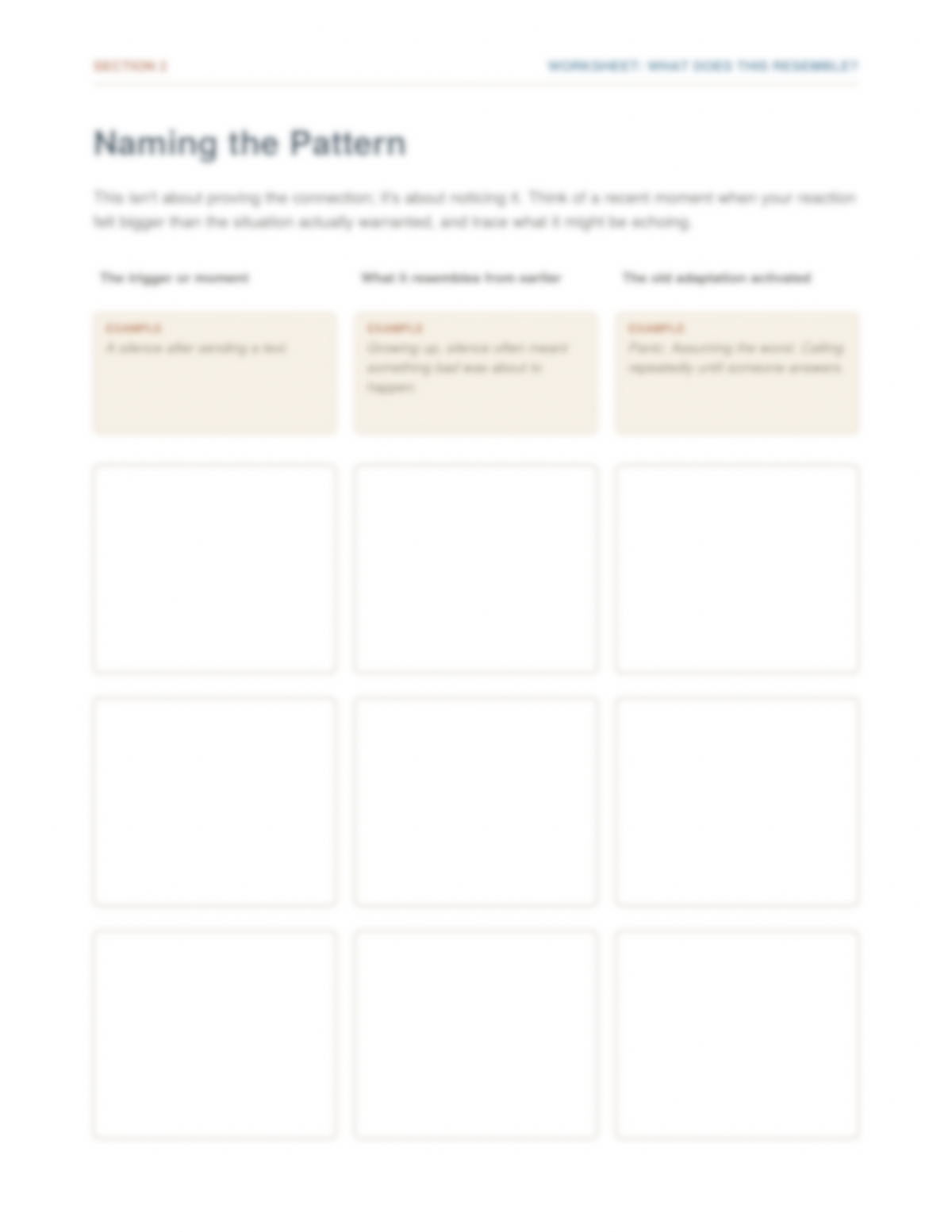
Pages from the book

What changes when you actually do the work
Working through this workbook means:
- ✓Recognizing which shield you reach for - making yourself small, or standing on high alert - as it happens.
- ✓Checking whether that old alarm is responding to the present or to the past.
- ✓Understanding how a shield gets built - what was learned or absorbed, not what happened - so it stops feeling like a personal failing.
- ✓Repositioning the armor, rather than carrying it everywhere or dropping it with nothing in its place.
- ✓Learning to trust your instincts about when more protection is needed and when less is.
- ✓Meeting whatever the shield was protecting you from with compassion instead of judgment.
- ✓Noticing the moments you're safe enough to take up more room, or to ease off the watch.


Alexander Gino
LCSW · Licensed PsychotherapistAlexander Gino is a licensed psychotherapist with more than a decade of clinical practice. He has worked across crisis, dual diagnosis, residential, medical, and outpatient settings, mostly with adults navigating grief, mood disorders, addiction, questions of meaning, and trauma. He completed certifications in addictions counseling and nutrition that have informed his clinical work and holds a master’s degree in social work (behavioral health concentration).
Compare your options
Working through more than one pattern? The complete set covers all ten.
The Pendulum of Trauma
- ✓23 pages, including 8 guided sections & exercises
- ✓The Rigid Armor/Invisibility recognition framework, explained in plain language
- ✓A reusable Weekly Pendulum Check-In tracker
- ✓Written by a licensed psychotherapist
- ✓Lifetime access
The Pendulum Complete Collection
- ✓All ten workbooks in the series: 208 pages with 68 guided sections & exercises
- ✓Covers Risk, Control, Hunger, Emotion, Addiction, Grief, Connection, Esteem, and Adaptation
- ✓10 reusable Weekly Pendulum Check-In trackers, one inside each workbook
- ✓Less than the cost of buying six workbooks individually
- ✓Written by a licensed psychotherapist
- ✓Lifetime access


Not sure where to start?
Take the free Pendulum Questionnaire to find out where you actually land - and which workbook fits you best.
- ✓See which of your patterns are swinging, across all ten areas
- ✓Find out if you lean toward one extreme, or both
- ✓Get personalized results, so you know where to start
Questions
Is this a replacement for therapy?
No. It's educational and reflective - a companion for work you might do in therapy, or a place to start before you're able to access it. It isn't a diagnostic or treatment tool.
Do I need to be in therapy to use this?
Not at all. Many people use it entirely on their own; others bring it into sessions with their own therapist.
How is this different from a journal?
A journal is a blank page. This gives you structure: short reflections paired with guided worksheets, built around a specific clinical framework, plus a reusable weekly tracker so the practice continues after the workbook itself is finished.
What format is it, and how do I use it?
A fillable 21-page PDF. Fill it out on your phone, tablet, or computer, or print it and work by hand - whichever you'll actually use.
Can I get all ten workbooks?
Yes. The complete 10-workbook set is available as a bundle, at less than the cost of buying six individually.


Mind&Gut
The Pendulum of Trauma Workbook
The Pendulum of Trauma Workbook
Couldn't load pickup availability


Related Workbooks
-
The Pendulum Complete Collection Workbook
Regular price $47.00Regular priceUnit price per -
The Pendulum of Risk Workbook
Regular price $9.00Regular priceUnit price per -
The Pendulum of Control Workbook
Regular price $9.00Regular priceUnit price per -
The Pendulum of Hunger Workbook
Regular price $9.00Regular priceUnit price per -
The Pendulum of Emotion Workbook
Regular price $9.00Regular priceUnit price per


